



Not every expense that builds your company’s image is tax-deductible in Poland. See how to tell advertising from representation, which costs are risky and how to document them.

Trading goods between companies in different European Union countries often means dealing with complex VAT rules. One of the most common cases is the intra-Community triangular transaction.
The concept is simpler than it sounds: three businesses from three different EU Member States carry out two consecutive supplies of the same goods, but the goods travel directly from the first to the last company. If the conditions are met, the simplified triangulation procedure lets the intermediary avoid VAT registration in the destination country.
What is a triangular transaction for VAT purposes?
A triangular transaction is a specific type of chain transaction involving:
- three VAT-registered businesses from three different EU Member States,
- two supplies of the same goods,
- one direct transport from the first supplier to the final customer.
The middle company, called the intermediary, buys the goods and resells them without ever receiving them physically.
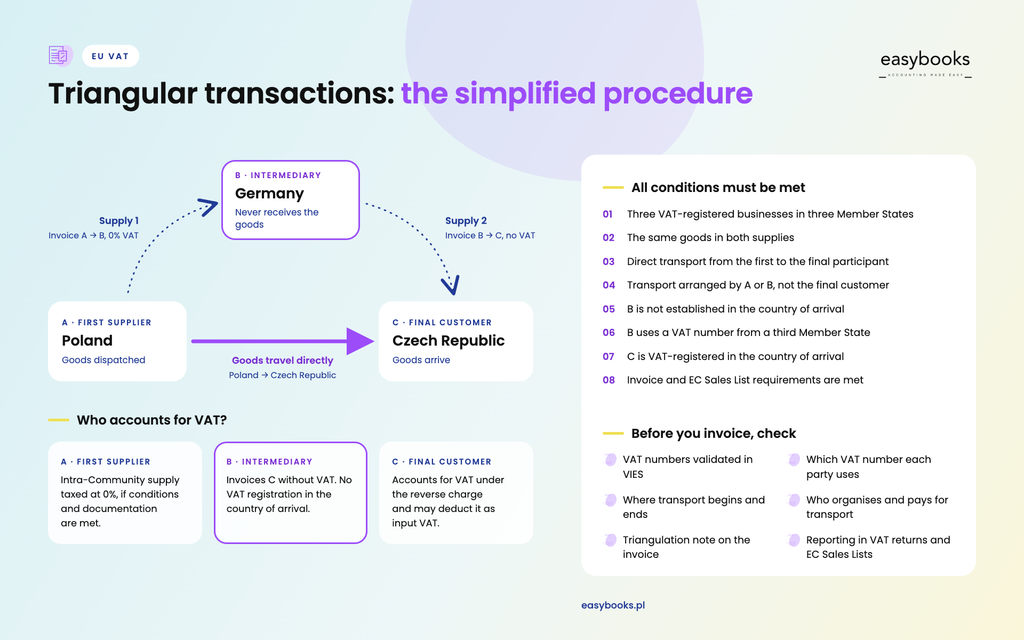
Triangular transaction example
- Company A (Poland) sells goods to Company B (Germany).
- Company B resells the same goods to Company C (Czech Republic).
- The goods are shipped directly from Poland to the Czech Republic.
Company B is the intermediary. It buys and resells the goods, but they never enter Germany. This structure can qualify for the simplified triangulation procedure.
Conditions for the simplified triangulation procedure
The simplified procedure does not apply automatically. All of the following conditions must be met:
- Three taxable persons are registered for intra-Community VAT in three different Member States.
- The same goods are the subject of both supplies.
- The goods are transported directly from the first to the final participant.
- The transport is arranged by or on behalf of the first or second participant, not the final customer.
- The intermediary is not established in the Member State where the transport ends.
- The intermediary uses a VAT number from a third Member State, not from the country of dispatch or the country of arrival.
- The final customer is VAT-registered in the country of arrival.
- The invoice and reporting requirements are met (see below).
Why the intermediary’s VAT number matters
The VAT identification number used by the intermediary is the most common source of errors. If Company B in our example used a Polish or Czech VAT number instead of its German one, the simplified procedure would not be available. Since the 2020 EU “Quick Fixes” reform, the VAT number the intermediary provides to its supplier also determines which supply in the chain is treated as the intra-Community (moving) supply.
Who accounts for VAT in a triangular transaction?
Under the simplified procedure, the VAT liability shifts to the final customer. Here is how each party treats the transaction:
| Participant | VAT treatment |
|---|---|
| First supplier (A) | Makes an intra-Community supply of goods, taxed at 0% (exempt under EU law) if the statutory conditions and documentation requirements are met. |
| Intermediary (B) | Makes an intra-Community acquisition that is deemed taxed in the destination country, and a supply to C without charging VAT. It does not need to register for VAT in the country of arrival. |
| Final customer (C) | Accounts for VAT on the purchase under the reverse charge mechanism and may deduct it as input VAT if the usual conditions are met. |
Invoicing and reporting requirements
The intermediary’s invoice to the final customer should:
- include the VAT numbers of both the intermediary and the final customer,
- contain no VAT amount,
- clearly state that it concerns a triangular transaction and that VAT is payable by the final customer, typically with a reference to Article 141 and Article 197 of the VAT Directive (2006/112/EC) or the equivalent national provision.
The intermediary must also report the supply in its EC Sales List (recapitulative statement) with the triangulation indicator. Missing this step is a frequent reason tax authorities deny the simplification.
Benefits of the simplified procedure
The main advantage is lower compliance burden for the intermediary. Without the simplified procedure, Company B would usually need to:
- register for VAT in the country where the transport ends,
- report an intra-Community acquisition there,
- charge and settle local VAT on the supply to the final customer.
Triangulation removes these obligations, provided every requirement is met.
Checklist before invoicing a triangular transaction
Before you issue the invoice, verify:
- the VAT status of all three participants (validate numbers in VIES),
- which VAT number each party uses in the transaction,
- where the transport begins and ends,
- who organises and pays for the transport,
- whether the invoice includes the required triangulation note,
- how the transaction will be reported in VAT returns and EC Sales Lists.
Frequently asked questions
Is a triangular transaction the same as a chain transaction?
No. Every triangular transaction is a chain transaction, but not every chain transaction qualifies for triangulation. The simplified procedure applies only to chains of three parties from three different Member States that meet the conditions above.
Can the simplified procedure apply if the final customer arranges transport?
Generally no. The transport must be arranged by or on behalf of the first supplier or the intermediary.
What happens if one condition is not met?
The simplified procedure does not apply. The intermediary may then have to register for VAT in the destination country and account for VAT there, which can lead to corrections, interest and penalties.
Does the triangular procedure apply to services?
No. It applies only to supplies of goods.
Summary
An intra-Community triangular transaction can significantly simplify VAT accounting in cross-border trade within the EU. The key is to correctly identify each participant’s role, determine which supply is linked to the transport, use the right VAT numbers and meet the invoicing and reporting requirements.
If your company takes part in supply chains with foreign partners, review the VAT treatment before issuing an invoice. Need help assessing a triangular transaction? Contact our tax advisers for a review of your specific transaction structure.
Hotels, fuel, parking and train tickets: not every business travel expense lets you deduct VAT in Poland. See how to document purchases, what KSeF changes and how to handle VAT on trips abroad.
In 2027, employees who opted out of PPK will be automatically re-enrolled. See the key dates and what employers in Poland must do: inform staff, verify who is covered and calculate contributions from April 2027.
Polish VAT payers can reclaim VAT paid in other EU countries through VAT-REF. Who qualifies, which costs are eligible, minimum amounts and the 30 September deadline.


